Non classé

WPBeginner Spotlight 22: Big Milestones, Better Backups, and WordPress Community Tools

Welcome to Issue 22 of WPBeginner Spotlight! March was full of exciting developments in the WordPress industry. In this issue, we are celebrating a massive decade-long milestone for one of our favorite WordPress form builders and exploring exciting new AI tools designed to put your WooCommerce promotions and course creation on autopilot. We’re also looking at major updates to how you can manage site staging and security. Let’s dive into all the latest WordPress news, plugin updates, and ecosystem developments you need to know about. WPBeginner Spotlight brings you a monthly roundup of the most important WordPress news, updates, and community happenings. 📅✨ Got something to share? Whether it’s a new product launch, a significant update, or an exciting event, reach out to us through our contact form, and your news could be featured in the next edition! WPForms Celebrates 10 Year Anniversary and Releases a Universal PayPal Integration WPForms is officially celebrating their 10th anniversary! This is a monumental milestone for the most popular WordPress form builder, which is trusted by over 6 million websites. WPForms was launched in 2016 to make it easier for users to add a contact form to their WordPress website. What started as a contact form plugin has now become an AI-powered solution that works with all the popular tools a website owner may need. Over the last decade, WPForms has consistently led the way in making form creation easy, accessible, and powerful for non-techy users and professionals alike. Last year alone, they released major new features each month including addons for Quizzes, PDFs, Camera and Map fields, and integrations for Google Drive, Google Calendar, Airtable, Make.com, n8n, and more. To celebrate this occasion, WPForms is offering 60% discount (for a limited time). Save 60% off WPForms (10th Anniversary Limited Deal) PayPal Integration for All WPForms Users To make this occasion even more special, the WPForms team has also released a highly requested feature: a Universal PayPal integration available to all users. Whether you are using the premium version or the free WPForms Lite, you can now seamlessly connect your forms to PayPal to accept payments, donations, and online orders. This update completely democratizes online payments for the WordPress community. It means anyone can start monetizing their website without any complicated eCommerce addon. Monitor Your WordPress Site with New Activity Log Plugin by Duplicator The Duplicator team has officially launched Activity Log, a brand-new plugin designed to give site owners a complete audit trail of every action taken on their WordPress website. This tool addresses a significant gap in default WordPress functionality by tracking who logged in, who changed settings, and exactly when specific content was modified. Activity Log tracks over 60 different types of events across categories such as user sessions, content edits, plugin updates, and theme changes. Each event is tagged with one of four severity levels—Critical, High, Medium, or Low—allowing administrators to instantly distinguish routine tasks from potential security threats like failed login attempts. The plugin also provides a searchable timeline that can be filtered by date, user, event type, or IP address. Beyond standard WordPress logging, Activity Log monitors specific actions that other plugins often miss, such as featured image changes and custom field updates. It also tracks critical background adjustments, including permalink structure shifts or admin email changes. This makes sure that significant configuration shifts never go unnoticed. Users can also set up a flexible email notification system to receive real-time alerts for high-severity events. That way, they can respond to critical issues immediately without manually checking the dashboard. For advanced users and developers, Activity Log includes full WP-CLI support for managing logs via the command line. This allows for exporting data in CSV or JSON formats, as well as automating log management across a large portfolio of websites. You can find out more about Activity Log here. WP Packages Launches as an Independent, Community-Funded Alternative for Developers The WordPress developer community has officially seen the launch of WP Packages, which is a fully independent and open-source Composer repository. 💡What is Composer? When developers build a WordPress site, they often use many different “parts” like plugins, themes, or specific sets of code (called libraries). Instead of the developer manually downloading each part, checking if it’s the right version, and making sure all those parts work together, Composer does it automatically Developed by Ben Word and the Roots team (the group behind Bedrock and Sage) this project provides a modern way for professional developers to manage WordPress plugins and themes as PHP dependencies. WP Packages serves as an open-source replacement for WPackagist by offering every free plugin and theme from the WordPress.org directory through a transparent build process. By being community-funded via GitHub Sponsors, the project remains community driven and focuses entirely on serving the technical needs of the developer ecosystem. Plus, transitioning to the new system is designed to be straightforward, with a dedicated migration script available for developers to update their existing projects. [New] WPVibe by SeedProd – Manage Your WordPress Site Directly from Claude Code, ChatGPT, or Cursor WPVibe by SeedProd has launched a new way to control your website using conversational AI. It lets you connect your self-hosted WordPress site to tools like Claude, ChatGPT, or Cursor. Instead of digging through complicated WordPress menus and settings, you can now perform complex admin tasks just by typing out what you want to do. While other similar tools focus on local developer environments, WPVibe provides remote access. This enables you to manage your site from any AI web interface while keeping your data on your own hosting. This ultimate “AI Site Assistant” simplifies management with several key features: Instant Content Control: Create posts, update pages, and manage comments or categories using natural language. Site Intelligence: Ask your AI to check active themes, installed plugins, and overall site health in seconds. Plugin Integration: Run specific tasks within tools like WPForms and AIOSEO via the new “Abilities API.” Multi-Step Automation: Use “Code Mode” to chain operations together, such as auditing a

WPBeginner Spotlight 22: Big Milestones, Better Backups, and WordPress Community Tools Lire la suite »

How to Prevent Content Theft on Your WordPress Membership Site (Before You Lose Members)

Your WordPress membership content could be circulating on public forums for free right now, and you wouldn’t know it until your revenue starts to drop. Many site owners rely on simple password protection, which does nothing to stop a member from sharing direct download links with non-paying users. The good news is that you don’t need to build custom security systems or hire a developer. The right combination of WordPress plugins and a few straightforward settings can dramatically reduce the risk of your content being stolen or redistributed. In this guide, I will show you exactly how to protect your site and keep your premium content exclusive to paying members. 🔐 TL;DR: Prevent membership content theft by following these tips: Restrict content to logged-in members and enforce access rules with MemberPress. Put key material behind a paywall and protect downloads with MemberPress Downloads or Easy Digital Downloads. Use content dripping to limit mass copying and improve retention. Watermark images and limit your RSS feed to excerpts to reduce scraping. Monitor the web with Google Alerts and Copyscape to catch unauthorized use early. Back everything up with copyright notices and a Creative Commons license to give yourself legal standing if you need to act. Why Content Protection Is Important for Membership Sites Content is the biggest asset for any membership site — it’s what people pay or sign up for. Whether that’s online courses, premium tutorials, downloadable resources, or a members-only community, your content is the reason people stick around. I’ve seen firsthand how quickly unprotected content can spread. Once someone shares your premium material outside your site, it becomes nearly impossible to remove it from the internet. That’s why protecting your content from the start is far easier than trying to recover it later. The good news is that a few smart strategies can go a long way. Here’s why content protection should be a priority for your membership site: 💰 Protect your revenue — If your premium content is freely available elsewhere, then potential members have little reason to pay for access. For example, a leaked online course can cost you dozens of lost subscriptions. 🌟 Maintain the value of your membership — If a paying member can find your premium content with a quick Google search, they will cancel. Keeping content genuinely exclusive is what makes the membership fee feel worth paying month after month. 🛑 Stop content scrapers and copycats — As your membership site grows and your content gains visibility, it becomes a more attractive target for content scrapers and copycats. Getting protections in place early means you are not scrambling to recover later. ⏱️ Protect the time and effort you invest — Building a quality online course or resource library can take hundreds of hours. If that material leaks and circulates for free, you lose the ability to charge for it, effectively giving away all that work with nothing in return. 🕹️ Control how your content is shared — Even well-meaning members may share content without realizing it’s a problem. Clear restrictions and licensing help set expectations from the start. There are also legal and ethical considerations to keep in mind. Unauthorized use of your content may violate copyright law, and having protections in place gives you a stronger foundation if you ever need to take action against someone who misuses your work. Here is an overview of the topics I will cover in this post: Tip 1. Restricting Content to Logged-In Members Tip 2. Putting Premium Content Behind a Paywall Restricing Access to Downloadable Files Tip 3. Setting Up Content Dripping Tip 4. Protecting Images with Watermarks Tip 5. Customizing Your RSS Feed Tip 6. Monitoring the Web for Unauthorized Content Usage Tip 7. Using a Plagiarism Checker to Search for Copies Tip 8: Setting Up Copyright Notices Applying for Copyright Adding the Copyright Notice to Your Site Making Your Copyright Dynamic Tip 9. Getting Creative Commons Licenses Getting Your License Badge Placing the License Prominently on Your Site Bonus Tip: How to Improve Your WordPress Site Security Frequently Asked Questions About Protecting Membership Content Next Steps to Grow Your Membership Site Tip 1. Restricting Content to Logged-In Members One of the most effective ways to protect your membership content is to make sure only registered members can access it. This prevents casual visitors, bots, and most scrapers from viewing your gated content in the first place. Think of it like a lock on the door. If someone can’t even see your premium content, then they can’t copy it, download it, or share it without your permission. For this, we recommend using MemberPress. It’s one of the best and most popular membership plugins available for WordPress, and it gives you powerful tools to control exactly who can access what on your site. At WPBeginner, we actually use MemberPress to run our video membership site. It’s been working really well for us, and you can learn more about it in our complete MemberPress review. To do this, you’ll need MemberPress installed and activated on your site. You can see ourbeginner’s guide to installing a WordPress plugin for a step-by-step guide. 💡 Note: MemberPress is a premium plugin. Make sure to create an account on the MemberPress website, download the zip file, and upload it to your WordPress website. Then, you’ll verify your license key. Once the plugin is active, go to MemberPress » Rules in your WordPress dashboard to start creating access rules. This is where you control which content is visible to which membership levels. With MemberPress, you can restrict pages, posts, videos, and downloadable resources so that only registered members can access them. For example, you might restrict all posts in a specific category to paying members. You could also limit access to individual pages, such as member-only forums, resource libraries, or private communities. This flexibility means you can tailor your content restrictions to match exactly how your membership site is structured. Even better, you can set up recurring payments so that members are billed automatically and maintain

How to Prevent Content Theft on Your WordPress Membership Site (Before You Lose Members) Lire la suite »

Matt: JAŸ-Z Returns

Since he spoke to Dean Baquet in 2017, JAŸ-Z hasn’t done an interview. Hov’s back! He sat down with GQ, and it’s a lovely listen and read. We played enough defense, 2026 is all about offense. Your morality defines who you are, not what you’ve attained.

Matt: JAŸ-Z Returns Lire la suite »

Gutenberg Times: Gutenberg Changelog #129 Artificial Intelligence, WordPress 7.0 and Gutenberg 22.8

In this episode, Birgit Pauli-Haack welcomes Beth Soderberg to discuss key updates in WordPress 7.0 and Gutenberg 22.8. They kick off with small talk about shifting seasons in Munich and Virginia before diving into the new content guidelines in Gutenberg 22.7, focused on standardizing editorial voice across AI and human content contributors. Both speakers express healthy skepticism about AI-generated content, stressing that while AI assists with research and “grunt work” like alt text or excerpts, the core value in writing remains human expertise and review. They caution about automation pitfalls and emphasize validating all AI outputs. The discussion shifts to the new WordPress AI connectors, which let users connect to services like OpenAI, Gemini, Anthropic Claude, and others—including local providers such as Olama and European alternatives like Mistral. Birgit Pauli-Haack explains the evolving infrastructure allowing developers to add and switch connectors with ease, and encourages the community to experiment and test. A central topic is the release of WordPress 7.0, with a highlight on the increased minimum PHP requirement to 7.4, likely to disrupt agencies with older sites. The admin’s new look-and-feel is poised to confuse some clients, demanding extra support from agencies. Beth Soderberg also celebrates practical improvements: cover block video embeds using external sources, block visibility by screen size, pattern overrides, breadcrumbs block, and streamlined font management. Both speakers note the importance of hidden, friction-reducing features and the advancement of developer-facing infrastructure. The episode closes with a preview of ongoing enhancements in Gutenberg 22.8 and beyond. Show Notes / Transcript Editor: Sandy Reed Logo: Mark Uraine Production: Birgit Pauli-Haack Show Notes Special Guest: Beth Soderberg Bethink Studio WordPress.org Profile + Slack Talks by Beth Soderberg Gutenberg Changelog #122 – Gutenberg 21.8 and WordPress 6.9 My Process for Building a Custom WordPress Theme in 2025 Bill Erickson,Ellen Bauer, Beth Soderberg: Case Studies – How to Prepare your Theme for Gutenberg And more AI in WordPress Guidelines Lands in Gutenberg 22.7 Call for Testing: Community AI Connector Plugins AI Provider for OpenRouter AI Provider for Ollama AI Provider for Mistral AI Experiements plugin WordPress Core and Gutenberg WordPress 6.9.2 retrospective WordPress 7.0 RC2 What’s new in Gutenberg 22.8? (25 March) Dev Notes Pattern Overrides in WP 7.0 Pattern Editing in WordPress 7.0 Block Visibility in WordPress 7.0 Dimensions Support Enhancements in WordPress 7.0 Custom CSS for Individual Block Instances New Block Support: Text Indent (textIndent) Introducing the Connectors API in WordPress 7.0 Introducing the AI Client in WordPress 7.0 Client-Side Abilities API in WordPress 7.0 Stay in Touch Did you like this episode? Please write us a review Ping us on X (formerly known as Twitter) or send DMs with questions. @gutenbergtimes and @bph. If you have questions or suggestions, or news you want us to include, send them to changelog@gutenbergtimes.com. Please write us a review on iTunes! (Click here to learn how) Transcript The transcript is in the works.

Gutenberg Times: Gutenberg Changelog #129 Artificial Intelligence, WordPress 7.0 and Gutenberg 22.8 Lire la suite »

Matt: Community Antibodies

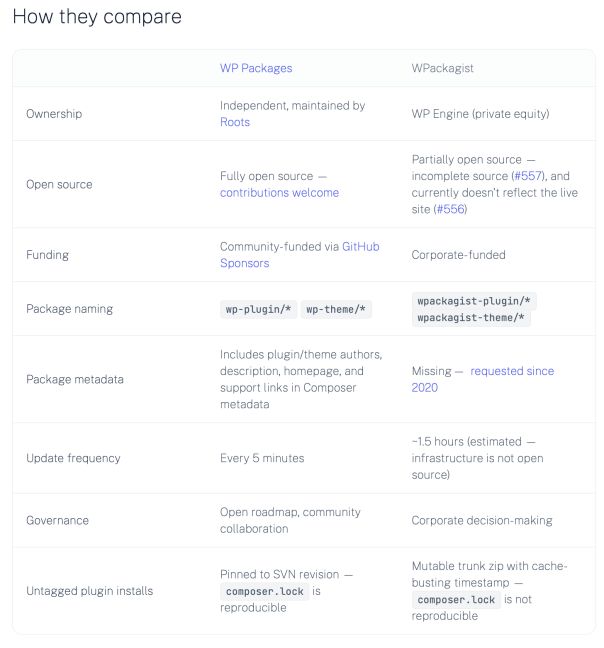
First, I want to say how great the jazz scene is in New York. I caught a little Latin at my go-to Guantamera last night, but the band seemed to be phoning it in a bit, so I walked over to Dizzy’s and heard an amazing big band performance by the Diva all-women Jass Orchestra, they had Clint Holmes leading vocals and I got Frank Sinatra / Count Basie vibes, so great to see such a tight big band. In WordPress, last week it was fun to see the company some call parasitic WP Engine acquire WPackagist. So a popular way to use WordPress with Composer, previously maintained by an awesome co-op agency in London, was now in the clutches of a company using its capital advantage to try to openwash its alleged bad behavior, probably in a process that wasn’t ideal for the sellers. Four days later, an awesome independent organization roots.io released WP Composer (renamed to WP Packages, in OpenClaw fashion) with 17x faster cold resolves than WPackagist. Check out their comparison page. It’s beautiful to see how resilient and nimble the antibodies in the WordPress community are. Major hat tip to Ben Word. In another type of antibody, Sid Sijbrandi, whom I previously talked about going into founder mode on his cancer, gave an incredible presentation at the Open AI Forum about how he ran a bunch of N-of-1 experiments and therapies to cure his terminal osteosarcoma. He’s also open-sourced 25TB of his data for cancer research. Incredible! If you want to see the future of health care, give Sid’s presentation a watch.

Matt: Community Antibodies Lire la suite »